





Green Time Climate Desk
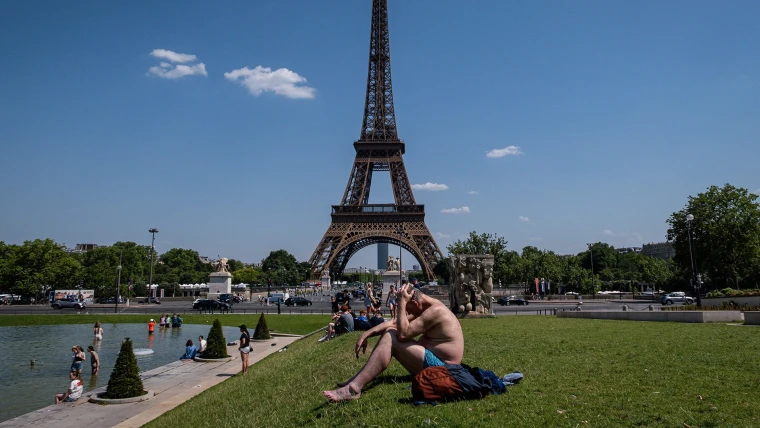
Europe is facing another dangerous summer as a record-breaking heatwave pushes temperatures near and above 40°C, disrupts transport and power systems, raises wildfire risks, and causes hundreds of deaths across the continent. In France alone, health authorities reported around 1,000 excess deaths during the latest heatwave, with older people among the most affected. Reuters reported that the heatwave began on June 20 and has damaged infrastructure, strained hospitals, and interrupted daily life in several countries.
The heat has spread from western Europe into central Europe, Italy and the Balkans. Italy placed 22 cities under red heat warnings, while Serbia expected temperatures of 39°C. Croatia issued red alerts for Zagreb, Split and Dubrovnik, and firefighters battled wildfires on the island of Vis. In some places, people stayed indoors through the day, schools and public life were disrupted, and families searched for shade, water and cooling spaces.
Scientists say this is not just a normal summer heatwave. Europe is the fastest-warming continent on Earth, warming more than twice as fast as the global average. Copernicus says Europe has already warmed by about 2.5°C compared with pre-industrial levels, and since the mid-1990s its temperature has been rising by about 0.56°C per decade.
The immediate weather pattern behind the heat is a “heat dome” — a high-pressure system that traps hot air, keeps skies clear and allows heat to build for days. AP explains that heat domes trap heat and humidity over a region, making already hot conditions longer and more intense. Human-caused climate change, driven mainly by burning coal, oil and gas, is making such heatwaves stronger, longer and more frequent.
A World Weather Attribution analysis reported by The Business Standard found that the latest western Europe heatwave would have been “virtually impossible” without human-caused climate change.
The analysis also found that a similar heatwave in June 1976 would have been about 3.5°C cooler, and that 45% of more than 800 European cities studied had recorded or were forecast to record their highest late-June heat stress levels.
The danger is not only daytime heat. Hot nights are especially deadly because the human body cannot recover from daytime stress. Reuters reported that scientists found climate change made the heatwave’s extreme night-time temperatures 100 times more likely than they would have been two decades ago.
The human cost is growing. The World Health Organization says studies found about 489,000 heat-related deaths each year globally between 2000 and 2019, with 36% of them in Europe. WHO also says Europe recorded about 61,672 heat-related excess deaths in the summer of 2022, while the 2003 European heatwave caused about 70,000 deaths.
Long-term health research points in the same direction. The 2026 Lancet Countdown Europe report, highlighted by the Potsdam Institute for Climate Impact Research, estimated around 62,000 heat-attributable deaths in Europe in 2024 and said almost every monitored European region has seen heat-related deaths rise over the past decade. Extreme heat warnings have also increased sharply compared with the 1991–2000 period.
The crisis is also hitting Europe’s economy and infrastructure. Rivers are becoming warmer and shallower, making it harder for power plants to cool systems. Hungary’s Paks nuclear plant reduced output because the Danube River was too warm, while Italy’s Po River flow dropped so much that seawater moved 18 km inland, raising fears for farming and wetlands.
For ordinary people, life is becoming harsher. Outdoor workers face dangerous conditions. Older people and children are more vulnerable. Families without air conditioning struggle through hot nights. Tourists seek shelter under umbrellas, cities open cooling spaces, and hospitals prepare for more heat-related illness.
Europe’s heatwave is a warning from a warming planet. Without rapid cuts in greenhouse gas emissions and stronger protection for vulnerable communities, extreme heat will become a more common part of summer life — not only in Europe, but across the world.